


Fenwal Heat Detectors
Vesda Air Sampling
Notifier Addressable Detectors
Notifier FSV-951 Early Warning Detector
Notifier Conventional Detectors
Explosion Proof Smoke Detector
ES2 Hazardous Location Signaling Devices
Vesda OSID FS-OSI-RI(A) Addressable Reflective Beam Smoke Detector
Li-Ion Tamer
Kidde Fenwal Heat Sensor Cable
Notifier Horn/Strobes
Kidde Horns & Strobes
Notifier Addressable Modules
Kidde Fenwal SmartOne Devices
Notifier Pull Stations
Kidde Fire Suppression Devices
Honeywell FSL100 Flame Detector
Fire Sentry UV/IR
Honeywell Gas Detection
THERMOFLEX Heat Detector
Potter Conventional Smoke Detector
Kidde Fenwal Smoke Detectors
Kidde Fenwal Air Sampling
Power Sonic Batteries














Smoke & Fire
Alarm Devices
Alarm Devices
Fenwal Heat Detectors
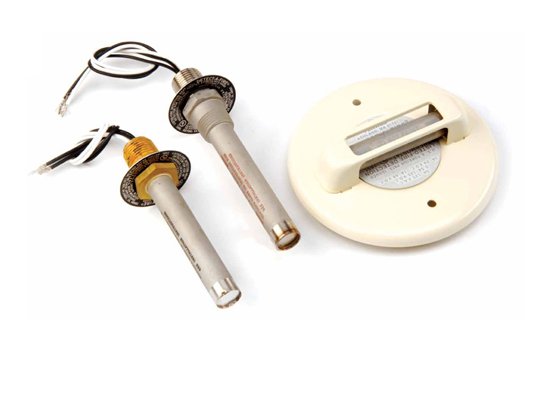
Fenwal Detect-A-Fire (D-A-F) detectors are rate-compensated thermal detectors that sense actual surrounding air temperature regardless of how fast a fire grows. They are used to signal overheat and fire conditions and to release suppression agents - clean agent, CO2, inert gas, wet chemical, dry chemical or water. The line covers 12 factory-set temperature points from 140 °F to 725 °F (60 °C to 385 °C) in vertical and horizontal configurations.
Control Fire Systems Ltd. is an authorized Kidde Fenwal Fire Systems distributor and First Fill Center in Toronto, Ontario, supplying, installing and servicing Detect-A-Fire detectors across Canada.
Detect-A-Fire specifications at a glance
| Specification | Value |
|---|---|
| Detection principle | Rate-compensated fixed temperature (thermal) |
| Temperature settings |
Vertical: 12 settings, 140–725 °F (60–385 °C)
Horizontal: 7 settings, 140–325 °F (60–163 °C) |
| Vertical models | 27121-0, 27121-20, 27120-0, 27120-22, 28020-3, 28021-5 |
| Horizontal models | 27021-0, 27021-1, 27020-0, 27020-1 |
| Contact configuration | Single Pole Single Throw (SPST), normally open (close on rise) or normally closed (open on rise) |
| Electrical rating (resistive) | 5.0 A @ 125 VAC; 0.5 A @ 125 VDC; normally open models also 2.0 A @ 24 VDC and 1.0 A @ 48 VDC |
| Response Time Index (RTI) | 99–148 (ft-s)^1/2 — Quick, Fast or Very Fast depending on model and setting |
| Maximum rated spacing | Up to 30 x 30 ft (9 x 9 m) on smooth ceilings; 20 ft for clean agent and CO2 systems |
| Housing | Type 300 stainless steel sensing shell, cold-rolled steel mounting facility, off-white finish |
| Weight | Vertical approx. 5 oz; horizontal approx. 10 oz |
| Low-temperature exposure | Tested to -22 °F (-30 °C) per UL 521 |
| Approvals | UL listed, ULC listed, FM Approved, CE (IEC 60947-1 / 60947-5-1) |
| Service life | Test annually per NFPA guidelines; replace after 10 years of continuous service |
| Availability | Supplied from the Control Fire Systems facility at 63 Advance Rd., Unit A, Toronto. Current stock and lead time confirmed per model at quote. |
How rate compensation works
The detector shell is made of a rapidly expanding alloy that tracks the surrounding air temperature closely. The inner struts use a slower-expanding alloy and are sealed inside the shell so they resist thermal absorption. In a slow-growing fire the shell and struts heat together and the contacts operate at the factory set point. In a fast-growing fire the shell expands quickly, the struts close, and the detector reacts sooner - the faster the fire grows, the faster the response.
A transient rush of warm air of up to 40 °F per minute - for example from a process oven - expands the shell without triggering the detector, which is why Detect-A-Fire virtually eliminates the false alarms common to rate-of-rise devices.
Detect-A-Fire vs fixed temperature vs rate-of-rise
| Device type | Under 10 °/min | 10–40 °/min | Over 40 °/min |
|---|---|---|---|
| Detect-A-Fire rate-compensated detector | 1st | 1st | 2nd - but at the selected protection level |
| Fixed-temperature detector | 2nd | 2nd | 3rd |
| Rate-of-rise detector | 3rd | 3rd | 1st - but may be a false alarm |
Vertical Detect-A-Fire models
Vertical detectors are approved for both ordinary and hazardous locations. For ordinary use they mount to any approved junction box with a 7/8 in opening using 1/2-14 NPT mounting nuts, and may be wired in or out of conduit. Normally open vertical detectors are supplied with four lead wires so system wiring can be supervised. Mounted in an appropriately classified box they are UL and ULC listed and FM Approved for hazardous locations.
| Model | Head material | Contact operation | Electrical rating (resistive only) |
|---|---|---|---|
| 27120-0 | Brass | Normally closed (open on rise) | 5.0 A 125 VAC; 0.5 A 125 VDC |
| 27120-22 | Stainless steel | Normally closed (open on rise) | 5.0 A 125 VAC; 0.5 A 125 VDC |
| 27121-0 | Brass | Normally open (close on rise) | 5.0 A 125 VAC; 0.5 A 125 VDC; 2.0 A 24 VDC; 1.0 A 48 VDC |
| 27121-20 | Stainless steel | Normally open (close on rise) | 5.0 A 125 VAC; 0.5 A 125 VDC; 2.0 A 24 VDC; 1.0 A 48 VDC |
| 28020-3 | Stainless steel (coupling head) | Normally closed (open on rise) | 5.0 A 125 VAC; 0.5 A 125 VDC |
| 28021-5 | Stainless steel (coupling head) | Normally open (close on rise) | 5.0 A 125 VAC; 0.5 A 125 VDC; 2.0 A 24 VDC; 1.0 A 48 VDC |
| 12-200001-00X | Stainless steel | Normally open (close on rise) | Specialty product, limited availability — contact us |
Note: models 27120 and 28020 are normally closed two-wire devices. They do not meet the requirements of NFPA 72 for use as initiating devices and are not FM listed with an RTI. Approximate weight 5 oz; all shell material is Type 300 stainless steel.
Vertical temperature settings and colour coding
| °F | °F tol. | °C | °C tol. | UL ft | ULC ft | FM ft | RTI | Colour |
|---|---|---|---|---|---|---|---|---|
| 140 | +7/-8 | 60 | +4/-5 | 50 | 50 | 20 | V-Fast | Black |
| 160 | +7/-8 | 71 | +4/-5 | 25 | 25 | 20 | V-Fast | Black |
| 190 | +7/-8 | 88 | +4/-5 | 50 | 50 | 25 | V-Fast | White |
| 210 | +7/-8 | 99 | +4/-5 | 25 | 50 | 25 | V-Fast | White |
| 225 | +7/-8 | 107 | +4/-5 | 25 | 50 | 25 | V-Fast | White |
| 275 | +/-10 | 135 | +/-6 | 25 | 50 | 25 | V-Fast | Blue |
| 325 | +/-10 | 163 | +/-6 | 50 | 50 | 25 | V-Fast | Red |
| 360 | +/-10 | 182 | +/-8 | 25 | 50 | 30 | V-Fast | Red |
| 450 | +/-15 | 232 | +/-10 | 25 | 50 | 30 | V-Fast | Green |
| 500 * | +/-15 | 260 | +/-10 | 50 | 50 | 30 | V-Fast | Orange |
| 600 * | +/-20 | 316 | +/-12 | N/A | 50 | 30 | V-Fast | Orange |
| 725 * | +/-20 | 385 | +/-12 | N/A | 50 | 30 | V-Fast | Orange |
* 500 °F, 600 °F and 725 °F settings are not available on normally closed detectors. For clean agent or CO2 suppression systems, ceiling spacing is 20 ft unless otherwise specified.
Horizontal Detect-A-Fire models
Horizontal detectors are designed for locations where appearance matters. The low-profile housing physically protects the detector and suits commercial, industrial, mercantile, institutional and marine applications in non-hazardous ("ordinary") locations. Flush-mount units fit standard 4 in octagonal electrical boxes; surface-mount units mount directly to ceilings or to 4 in junction boxes. Canadian Electrical Code requires mounting to an electrical junction box. Horizontal detectors use connector blocks instead of lead wires.
| Model | Mounting style | Contact operation | Electrical rating (resistive only) |
|---|---|---|---|
| 27020-0 | Flush mount | Normally closed (open on rise) | 5.0 A 125 VAC; 0.5 A 125 VDC |
| 27020-1 | Surface mount | Normally closed (open on rise) | 5.0 A 125 VAC; 0.5 A 125 VDC |
| 27021-0 | Flush mount | Normally open (close on rise) | 5.0 A 125 VAC; 0.5 A 125 VDC; 2.0 A 24 VDC; 1.0 A 48 VDC |
| 27021-1 | Surface mount | Normally open (close on rise) | 5.0 A 125 VAC; 0.5 A 125 VDC; 2.0 A 24 VDC; 1.0 A 48 VDC |
Horizontal temperature settings
| °F | °F tol. | UL ft | ULC ft | FM ft | RTI | Colour |
|---|---|---|---|---|---|---|
| 140 | +7/-8 | 50 | 50 | 20 | Quick | Black |
| 160 | +7/-8 | 25 | 25 | 20 | Quick | Black |
| 190 | +7/-8 | 50 | 50 | 25 | Fast | White |
| 210 | +7/-8 | 25 | 50 | 25 | Fast | White |
| 225 | +7/-8 | 25 | 50 | 25 | Fast | White |
| 275 | +/-10 | 25 | 50 | 25 | Fast | Blue |
| 325 | +/-10 | 50 | 50 | 25 | Fast | Red |
Note: models 27020-0 and 27020-1 are normally closed two-wire devices; they do not meet NFPA 72 requirements for use as initiating devices and are not FM listed with an RTI. Approximate weight 10 oz.
Response Time Index and detector spacing
Detect-A-Fire detectors are not position sensitive - "horizontal" and "vertical" describe the most common mounting configuration, and either type can be mounted in either orientation depending on the application.
| Model | Configuration | Set point | RTI | RTI class | RTI rated spacing |
|---|---|---|---|---|---|
| 27021-0 / 27021-1 | Horizontal, flush / surface, normally open | 140 °F (60 °C), 160 °F (71 °C) | 110 | Quick | 20 x 20 ft (6 x 6 m) |
| 27021-0 / 27021-1 | Horizontal, flush / surface, normally open | 190–325 °F (88–163 °C) | 140 | Fast | 25 x 25 ft (8 x 8 m) |
| 27121-0 / 27121-20 / 28021-5 | Vertical, brass / stainless / coupling head, normally open | 140–725 °F (60–385 °C) |
99 at 140–160 °F;
148 at 190 °F and above |
Very Fast | 30 x 30 ft (9 x 9 m) |
Spacings above are distances between detectors on smooth ceilings; distances from partitions or walls are half the figure shown. Always confirm the layout with the Authority Having Jurisdiction (AHJ) before installation.
Ceiling height derating (NFPA 72)
| Ceiling height above | Up to and including | Derating factor |
|---|---|---|
| 0 m / 0 ft | 3.05 m / 10 ft | 1.00 |
| 3.05 m / 10 ft | 3.66 m / 12 ft | 0.91 |
| 3.66 m / 12 ft | 4.27 m / 14 ft | 0.84 |
| 4.27 m / 14 ft | 4.88 m / 16 ft | 0.77 |
| 4.88 m / 16 ft | 5.49 m / 18 ft | 0.71 |
| 5.49 m / 18 ft | 6.10 m / 20 ft | 0.64 |
| 6.10 m / 20 ft | 6.71 m / 22 ft | 0.58 |
| 6.71 m / 22 ft | 7.32 m / 24 ft | 0.52 |
| 7.32 m / 24 ft | 7.93 m / 26 ft | 0.46 |
| 7.93 m / 26 ft | 8.54 m / 28 ft | 0.40 |
| 8.54 m / 28 ft | 9.14 m / 30 ft | 0.34 |
Hazardous location classification
| Model | Hazardous location | Fitting required for UL / ULC listing and FM approval |
|---|---|---|
| 27120-2, 27121-20, 28020-3, 28021-5 | Class I, Groups A, B, C and D; Class II, Groups E, F and G | Mount the detector to a suitable listed fitting in accordance with the National Electrical Code and/or the local authority having jurisdiction. |
| 27120-0, 27121-0 | Class I, Groups B, C and D; Class II, Groups E, F and G | Mount the detector to a suitable listed fitting in accordance with the National Electrical Code and/or the local authority having jurisdiction. |
An optional explosion-proof mounting box, P/N 06-116317-001, is available and complies with NEC Class I Groups A, B, C, D; Class II Groups E, F, G; Class III and UL Standard 1203. The explosion-proof mounting box is purchased separately from the detector.
Agency approvals
| Agency | File number | Location |
|---|---|---|
| UL | S492 | Ordinary |
| UL | E19310 | Hazardous |
| ULC | CS341-E | Ordinary and hazardous |
| FM | J.I. OV2HO.AE | Hazardous |
| FM | 17302 | Ordinary |
| UL | S2410 | Ordinary (600 °F and 725 °F) |
| UL | E89599 | Hazardous (600 °F and 725 °F) |
| CE | IEC 60947-5-1 | — |
Detect-A-Fire detectors are UL and ULC listed and FM Approved both as fire detection thermostats (close on temperature rise) and as releasing devices (open on temperature rise). The product family has been evaluated to IEC 60947-1 and IEC 60947-5-1 and documented under Intertek Report No. 102294754 BOX-001 as an overheat detector, with rated insulation and impulse voltages of 1500 VAC.
How to select a Detect-A-Fire detector
- Choose the configuration. Vertical models (27121, 27120, 28021, 28020) for hazardous locations, high temperatures up to 725 °F and the widest spacing; horizontal models (27021, 27020) for ordinary locations where a low-profile appearance matters.
- Choose the contact operation. Normally open (close on rise) for initiating devices under NFPA 72 and for supervised circuits; normally closed (open on rise) for release applications on two-wire circuits.
- Choose the temperature setting. Select a set point at least 100 °F above the maximum expected ambient temperature to avoid nuisance activation.
- Add options if required: ULC label on any temperature setting; fluorocarbon coating for improved corrosion resistance on models 27120-22, 27121-20, 28020-3 and 28021-5 up to a maximum of 500 °F; extended lead wires on selected models and temperatures.
Ordering example: 27121-20 at 190 °F with fluorocarbon coating.
Not sure which set point your hazard needs? Send us the maximum ambient temperature and ceiling height and we will specify the model, setting and spacing.
Stocked models and availability in Canada
Model 27121-0 (vertical, brass head, normally open) is a stocked detector in all twelve temperature settings from 140 °F to 725 °F. Other models and settings are stocked in limited quantities or manufactured on demand.
| Model | Configuration | Settings available | Supply | Action |
|---|---|---|---|---|
| 27121-0 | Vertical, brass head, normally open | 12 settings, 140–725 °F | Toronto facility — stock confirmed at quote | Request price |
| 27121-20 | Vertical, stainless, normally open | 12 settings, 140–725 °F | Toronto facility — stock confirmed at quote | Request price |
| 27021-1 | Horizontal, surface, normally open | 7 settings, 140–325 °F | Toronto facility — stock confirmed at quote | Request price |
| 28021-5 | Vertical, coupling head, normally open | 12 settings, 140–725 °F | Toronto facility — stock confirmed at quote | Request price |
The “Settings available" column is taken from the Fenwal F-12-0-001 datasheet, so the table is publishable as it stands. Per-model stock counts and firm lead times are the only fields the warehouse still needs to fill in.
As an authorized Kidde Fenwal distributor and First Fill Center we also supply the matching release panels, cylinders and agent - see Fenwal 732 release panels.
Fenwal Series 17343 Fire & Overheat Detector
The Fenwal Series 17343 monitors for fire and overheat conditions in very high temperature environments. It is recommended as an alarm device that alerts supervisory staff so corrective measures can be initiated. Like the Detect-A-Fire line it provides rate compensation, activating at a predetermined danger point whether heat builds slowly or quickly.
- Vertical mount - 5 fixed settings from 140 °F to 725 °F
- Single Pole Single Throw (SPST)
- Close on temperature rise
Where Detect-A-Fire detectors are used
- Schools, factories, offices, libraries and other non-residential buildings
- Power generation facilities
- Gas station islands and fuel dispensing canopies
- Paint spray booths
- Commercial kitchen range hoods
- Engine compartments and heavy industrial vehicles
- Release circuits for clean agent, CO2, inert gas, wet chemical, dry chemical and water suppression systems
We install and service these systems for industrial facilities, power generation, data centres and server rooms, automotive facilities and commercial kitchens across Canada.
Testing, maintenance and replacement
- Detect-A-Fire detectors are self-restoring and testable - there is nothing to replace after a test.
- Detectors must be tested annually in accordance with NFPA guidelines or local fire codes.
- Replace a detector after any fire or heat-related event, after any mechanical damage, or after 10 years of continuous service.
- In corrosive environments, protect the detector to obtain optimal performance and maximum life — a fluorocarbon coating option is available.
- Detectors are temperature preset at the factory and cannot be field-adjusted.
Control Fire Systems performs code-compliant fire alarm device testing, inspection and suppression system service in Ontario, from Toronto, Mississauga and Ottawa. Equipment supply, cylinder refilling, hydrostatic testing and Halon recycling are available Canada-wide.
Buying Fenwal heat detectors in Canada
- Authorized Kidde Fenwal Fire Systems distributor and First Fill Center — genuine parts, factory-backed system design support.
- Stocked in Toronto at 63 Advance Rd., Unit A, serving the GTA, Mississauga, Ottawa and Calgary, with equipment supply across Canada.
- Factory-certified technicians for design, installation and maintenance of Kidde and Fenwal detection, control and suppression equipment.
- Full lifecycle service - hazard analysis, system design, installation, annual inspection, cylinder refilling and 24-hour emergency service.
- Established 1975 — over 50 years in operation. Canadian-owned and privately held, a named supplier under a City of Toronto contract award, and rated 4.8 / 5 from 37 reviews on N49. Member of the FSSA, the CFAA and NAFED.
“I purchased a fire alarm from you and it helped us detect a kitchen fire last week." — Jerry Manzo
“Professional, fast and neat. They did all my fire system work for my commercial building. On-time. They have great technicians." — Sina Jam
“They came in time for our fire alarm and suppression system installation last week and provided fast and efficient service." — T. Friesen
Related detection products
- Kidde Fenwal linear heat sensor cable - continuous line-type heat detection for cable trays and conveyors
- THERMOFLEX heat detector - digital linear heat detection alternative
- Kidde Fenwal SmartOne devices - addressable detection
- Fenwal 732 release panel - single-hazard release control
- Explosion-proof smoke detectors - for the same classified areas
- All smoke & fire alarm devices
Page last reviewed
Technical data from Fenwal Controls datasheet F-12-0-001, Rev. BC. Page last reviewed September 2026 by the Control Fire Systems technical services team.
Frequently asked questions
What is a rate-compensated heat detector?
A rate-compensated heat detector senses the actual temperature of the surrounding air regardless of how fast that temperature is rising. In the Fenwal Detect-A-Fire, a rapidly expanding outer shell tracks air temperature while slower-expanding inner struts resist thermal absorption, so the contacts operate at the factory set point in both slow and fast fires.
How is Detect-A-Fire different from fixed-temperature and rate-of-rise detectors?
A fixed-temperature detector must be heated all the way through to its alarm temperature, so it can lag in a fast fire. A rate-of-rise detector triggers on the speed of the temperature increase and is prone to false alarms from harmless thermal gradients such as a rush of warm air from a process oven. Detect-A-Fire responds at its set point in slow fires and responds sooner as fire growth accelerates, while ignoring transient warm-air excursions of up to 40 °F per minute.
Which temperature setting should I choose?
Fenwal Controls recommends selecting a set point at least 100 °F above the maximum expected ambient temperature of the protected space, to avoid nuisance activations. Vertical models offer twelve settings from 140 °F to 725 °F; horizontal models offer seven settings from 140 °F to 325 °F.
What is the difference between the 27121 and the 27021?
The 27121 is the vertical configuration - approved for hazardous locations, available in all twelve temperature settings up to 725 °F, with a Very Fast RTI and rated spacing up to 30 x 30 ft. The 27021 is the low-profile horizontal configuration for ordinary locations, available in seven settings up to 325 °F, with connector blocks instead of lead wires.
What is the difference between normally open and normally closed models?
Normally open models (27121, 27021, 28021) close on temperature rise and are used as initiating devices on supervised circuits. Normally closed models (27120, 27020, 28020) open on temperature rise; they are two-wire devices and do not meet NFPA 72 requirements for use as initiating devices.
Can Detect-A-Fire detectors be used in hazardous locations?
Yes. Vertical models 27121-20, 28021-5, 27120-2 and 28020-3 are rated for Class I Groups A, B, C and D and Class II Groups E, F and G when mounted to a suitable listed fitting. Models 27120-0 and 27121-0 are rated for Class I Groups B, C and D and Class II Groups E, F and G. An optional explosion-proof mounting box, P/N 06-116317-001, is available separately.
What spacing should be used, and how does ceiling height affect it?
Rated spacing on smooth ceilings is 20 x 20 ft for Quick-response horizontal models, 25 x 25 ft for Fast, and up to 30 x 30 ft for Very Fast vertical models; distances from walls or partitions are half those figures. Spacing must be derated as ceiling height increases per NFPA 72 - for example by a factor of 0.64 at 20 ft and 0.34 at 30 ft. For clean agent and CO2 suppression systems, spacing is 20 ft unless otherwise specified.
How often do Fenwal heat detectors need to be tested or replaced?
Detect-A-Fire detectors must be tested annually per NFPA guidelines or local fire code. They should be replaced after any fire or heat-related event, after any mechanical damage, or after 10 years of continuous service.
Are Fenwal Detect-A-Fire detectors approved for use in Canada?
Yes. They are ULC listed under file CS341-E for both ordinary and hazardous locations, in addition to UL listing and FM approval. Canadian Electrical Code requires horizontal detectors to be mounted to an electrical junction box.
Can I buy a single Fenwal heat detector, or only complete systems?
Both. Equipment supply is a standalone service line at Control Fire Systems — individual detectors, panels, devices and agent are sold as a supplier, as well as complete detection and release packages, and contractors and consultants regularly buy single devices and calculations from us. Call 1-866-384-1280 or request a price for the model and setting you need.