













Clean Agent Fire Suppression Systems


A clean agent fire suppression system puts out a fire using an electrically non-conductive gas that leaves no residue. The agent floods a sealed room and stops combustion within seconds, with no water, foam or dry chemical to clean up. These systems protect data centres, control rooms, medical imaging suites and archives, where the damage from suppression can exceed the damage from the fire.
How Clean Agent Fire Suppression Works
Clean agents suppress fire in one of two ways.
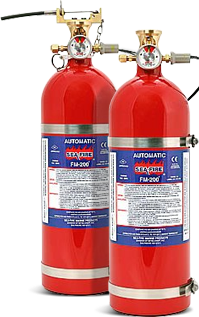
Halocarbon agents, including FK-5-1-12 and FM-200, absorb heat from the flame and interrupt the chemical chain reaction that keeps combustion going. NFPA 2001 requires a halocarbon system to reach design concentration within 10 seconds in enclosures up to 10,000 cubic feet.
Inert gas agents such as IG-55, IG-541 and IG-100 work by displacement. They reduce oxygen in the room to roughly 12 to 14 percent, below the level a fire needs to sustain itself but high enough that occupants can still evacuate. Inert systems discharge over a longer window, typically 60 seconds.
Either agent type can be installed as a total flooding system, which protects an entire sealed enclosure, or as a local application system aimed at one specific hazard such as a machine or an electrical cabinet.
The agent only works if the room holds it. NFPA 2001 requires the concentration to stay above its effective level for at least 10 minutes after discharge, and for unoccupied data centres an authority having jurisdiction may require 20 to 30 minutes. Enclosure integrity is part of the system, not a detail of the building.
Comparing Clean Agents: FK-5-1-12, FM-200, Inert Gas and CO₂
Four agents cover almost every application, and they differ on three things that matter in practice: how much space the cylinders take up, whether the room can be occupied when the system discharges, and what the agent's environmental profile means for its long-term availability.
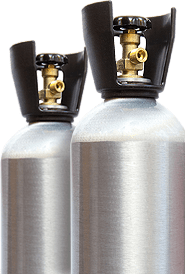
FK-5-1-12 and FM-200 store as liquids under pressure, so a system needs less cylinder space and shorter pipe runs than an inert gas equivalent. Inert gases store as compressed gas at 200 to 300 bar and need several times the cylinder volume for the same protected space, which is often the deciding factor in a retrofit. CO₂ is the least expensive of the four, but it reaches extinguishing concentration at levels that are lethal to people, so it belongs only in spaces that are normally unoccupied.
| FK-5-1-12 (Novec 1230, Fluoro-K) | FM-200 (HFC-227ea) | Inert gas (IG-55, IG-541, IG-100) | CO₂ | |
|---|---|---|---|---|
| Suppression method | Heat absorption | Heat absorption and chemical chain interruption | Oxygen displacement | Oxygen displacement |
| Design concentration | 4.5% Class A, 5.9% Class B | 6.25% to 9% | 30% to 45% | 34% and above |
| NOAEL | 10% | 9% | Not applicable | Not applicable |
| Discharge time | 10 seconds | 10 seconds | 60 seconds | Varies by design |
| GWP (100-year) | Less than 1 | 3,220 | 0 | 1 |
| ODP | 0 | 0 | 0 | 0 |
| Atmospheric lifetime | 5 days | 31 to 42 years | Not applicable | Not applicable |
| Occupied spaces | Yes, with a wide safety margin | Yes, EPA permits up to 9% | Yes, with egress planning | No. Normally unoccupied spaces only |
| Storage | Compact, 25 to 70 bar | Compact | Large, 200 to 300 bar | Large |
| Standard | NFPA 2001 | NFPA 2001 | NFPA 2001 | NFPA 12 |
The gap between design concentration and NOAEL is the margin that makes a space safe to occupy during discharge. Of the two halocarbons, FK-5-1-12 has the wider margin: it suppresses at 4.5 percent and shows no observed adverse effect until 10 percent. FM-200 runs 6.25 to 9 percent against a NOAEL of 9 percent, which is why room volume calculations and system design matter more with it.
Novec 1230 Has Been Discontinued. What That Means for Your System
3M stopped manufacturing Novec 1230 at the end of 2025 as part of its exit from PFAS production. If you own a Novec 1230 system, the headline is more alarming than the situation.
Novec 1230 was 3M's brand name for FK-5-1-12, not a proprietary chemistry. The agent itself is still in production from other suppliers, and your system was engineered around FK-5-1-12, not around 3M. Fike, for example, now supplies SF 1230 through a partnership with Standard Fluids as a drop-in replacement for existing Novec installations. Control Fire Systems stocks FK-5-1-12 and Fluoro-K for the same purpose.
In practical terms: your system does not need to be replaced, redesigned or re-listed. What changes is the supply source for the agent, which matters when a system needs recharging after a discharge or a cylinder refill after hydrostatic testing. Our Toronto facility is ULC listed for the repair, recharge and refill of Novec 1230, FK-5-1-12, FM-200 and HFC-227 cylinders, so an existing system stays serviceable.
FM-200 sits under a different timeline. Hydrofluorocarbons are being phased down 85 percent by 2036 under the US AIM Act, and Canada runs its own HFC phase-down schedule under CEPA, both of which will gradually tighten supply and raise cost for HFC-227ea. [CONFIRM: Canadian schedule and target year] That is a phase-down, not a ban, and existing FM-200 systems remain compliant and serviceable today. Factor it into a replacement decision over the next decade rather than treating it as an emergency.
Where Clean Agent Systems Are Used
Clean agents are specified wherever the contents of a room are worth more than the room, or where the business stops when the equipment does.
Data centres and server rooms. Agent discharge leaves no residue on boards or connectors, so hardware that was not in the fire keeps running. Sprinklers in the same space would take the room offline whether or not they reached the fire.
Healthcare. MRI and CT suites combine high equipment value with occupied space. FK-5-1-12 and FM-200 both discharge at concentrations that allow people to remain and evacuate.
Power generation. Control rooms, switchgear and turbine enclosures need a non-conductive agent that will not damage the equipment it protects.
Renewable energy and battery energy storage. Battery rooms present a hazard that water handles poorly and that keeps reigniting. Agent selection here depends on the cell chemistry and the enclosure.
Military and government buildings. Communications rooms, records storage and secure facilities, where a sprinkler discharge creates a second incident.
High-rise buildings. Elevator machine rooms, telecom closets and building control rooms, often in spaces too small to justify a sprinkler zone of their own.
Room Integrity Decides Whether the System Works
A clean agent system is engineered around a sealed volume. The agent has to reach design concentration and stay there long enough to put the fire out and keep it out, which NFPA 2001 sets at a minimum of 10 minutes. A room that leaks loses concentration before that window closes, and the fire can reignite once the agent falls below its effective level.
Leakage is rarely visible. Cable penetrations, gaps above a suspended ceiling, poorly sealed door undercuts and shared return air plenums all drain agent out of the protected space at rates that no one notices until the system discharges.
This is what a door fan test measures. The test pressurises and depressurises the enclosure, measures the leakage area, and calculates the predicted hold time for the installed agent quantity. If the room falls short, it gets sealed and retested. ASTM E2174 governs the method.
Room integrity is not a one-time acceptance item either. Every cable pull, renovation and HVAC change alters the enclosure, which is why the test is repeated rather than filed away.
Control Fire Systems performs fan air leak testing across the GTA and nationally.
What a Clean Agent System Is Made Of
Five elements make up a working system.
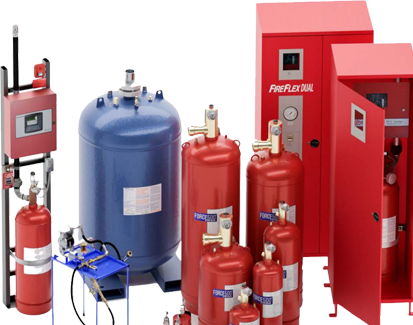
Agent storage. Cylinders sized to the protected volume, mounted in or near the room, with a valve assembly and a pressure gauge or supervisory switch.
Distribution. Pipe and nozzles balanced by hydraulic calculation so that the agent reaches design concentration everywhere in the enclosure within the discharge window, not just near the nozzles.
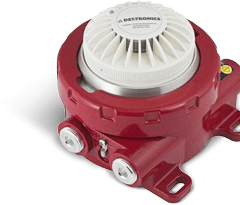
Detection. Smoke, heat or aspirating detection, depending on how early the system needs to see a fire. VESDA aspirating detection samples air continuously and flags combustion well before a spot detector would, which matters in rooms with high airflow such as data centres.
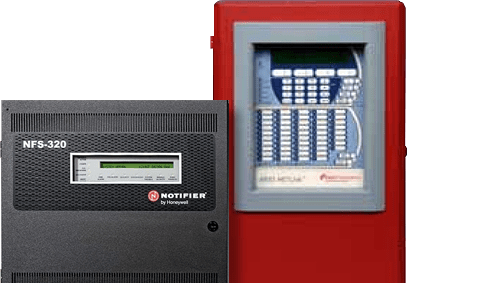
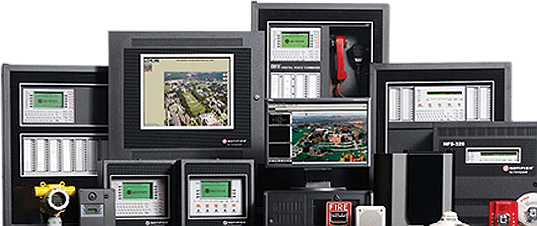
Releasing control. A releasing fire alarm panel that confirms detection, runs the pre-discharge sequence, shuts down HVAC where required, and fires the actuator. Cross-zoned detection is standard: two detectors have to agree before the system releases.
Manual control. A manual release for discharging on command, and an abort switch that holds the countdown while someone investigates.
Inspection, Testing and Recharge Under NFPA 2001
NFPA 2001 sets the maintenance schedule, and an authority having jurisdiction can require more.
| Interval | What happens |
|---|---|
| Monthly | Visual check: cylinders in place and undamaged, gauges in range, manual actuators accessible, nothing blocking nozzles |
| Every 6 months | Cylinders weighed or measured to confirm agent quantity still meets design concentration |
| Annually | Functional test of detection, releasing panel, control and supervisory circuits, and the full discharge sequence without releasing agent |
| Every 5 years | Hydrostatic testing of cylinders under DOT 49 CFR §180.205. Cylinders that fail are condemned, not repaired |
| After any discharge | Recharge, plus investigation of what triggered it before the system is returned to service |
NFPA 2001 allows a maximum agent loss of 5 percent between recharges. A cylinder that has drifted below that threshold is not a maintenance note, it is a system that will under-concentrate in a real fire.
Recharge is where many building owners discover their contractor cannot actually do the work. Our Toronto facility is ULC listed for the repair, recharge and refill of Novec 1230, FK-5-1-12, FM-200 and HFC-227 cylinders, and we hold agent stock rather than ordering it after your system has already discharged. [CONFIRM: agent stock claim]
Cylinder testing Cylinder refilling and recharge System service and inspections
What a Clean Agent System Costs
Cost is driven by the volume of the protected space, not its floor area, because the agent quantity is calculated from cubic volume and design concentration. A server room with a 14-foot ceiling costs more to protect than the same floor plan at 9 feet.
Four other factors move the number: the agent chosen, the hazard class, how much detection the room needs, and the condition of the enclosure. A room that fails a door fan test needs sealing work before the system is worth commissioning, and that cost sits outside the system quote.
| Typical installed cost [CONFIRM] | |
|---|---|
| Server room, approx. 500 sq ft | $10,000 to $35,000 CAD |
| Data centre, approx. 5,000 sq ft | $105,000 to $350,000 CAD |
| Rule of thumb | $20 to $70 CAD per square foot |
Installed cost covers design, hydraulic calculation, cylinders and agent, pipe and nozzles, detection and releasing panel, installation and commissioning.
Ongoing costs are smaller and more predictable: [CONFIRM]
| Annual | |
|---|---|
| Inspection and testing | $700 to $2,800 CAD |
| Maintenance agreement | $1,400 to $4,200 CAD |
| Recharge after a discharge | $4,000 to $21,000 CAD, depending on agent and cylinder count |
Hydrostatic testing lands every five years and is quoted per cylinder.
For a firm number, the only honest answer is a site assessment. Room volume, ceiling construction, existing detection and enclosure integrity all have to be measured rather than assumed.
Replacing a Halon 1301 System
If you still operate a Halon 1301 system in Canada, there is one fact that governs every decision about it: you cannot legally recharge it.
Canada's Ozone-depleting Substances Regulations, 1998 ban the manufacture, import and export of bulk new halon. The Federal Halocarbon Regulations, 2003 allowed a one-time recharge of fixed systems, and that window closed on 31 December 2009. Since then, charging a fixed halon system has been prohibited except for aircraft, military vehicles and military ships, or under an Environment Canada permit. [CONFIRM: federal vs provincial scope]
An existing halon system installed before the prohibitions may continue to operate. What it cannot do is survive a discharge. One activation, accidental or otherwise, and the system is finished as a protection asset while the room it protected goes unprotected.
That is the real argument for retrofitting rather than any environmental one. FK-5-1-12 and FM-200 both work in the spaces halon was specified for, and in many retrofits the existing pipe and nozzle layout can be reused after recalculation, which keeps the project cost well below a new installation. [CONFIRM]
Halon also cannot simply be vented. Release is prohibited under the Federal Halocarbon Regulations except to fight an actual fire, and the agent has to be recovered before a system is decommissioned or dismantled, following ULC/ORD-C1058.5-2004.
Control Fire Systems operates a Halon 1301 recycling centre and holds contracts with the military and the airline industry, the two categories where halon use is still permitted. We recover the agent from decommissioned systems, which keeps it in the permitted supply chain rather than destroyed.
Why Control Fire Systems
We have been installing and servicing special hazard fire suppression systems from Toronto since 1975.
ULC listed for recharge. Our facility at 63 Advance Rd. is ULC listed for the repair, recharge and refill of Novec 1230, FK-5-1-12, FM-200 and HFC-227 cylinders. Most fire protection contractors subcontract this work. We do it in house, which is why we can commit to turnaround on a recharge.
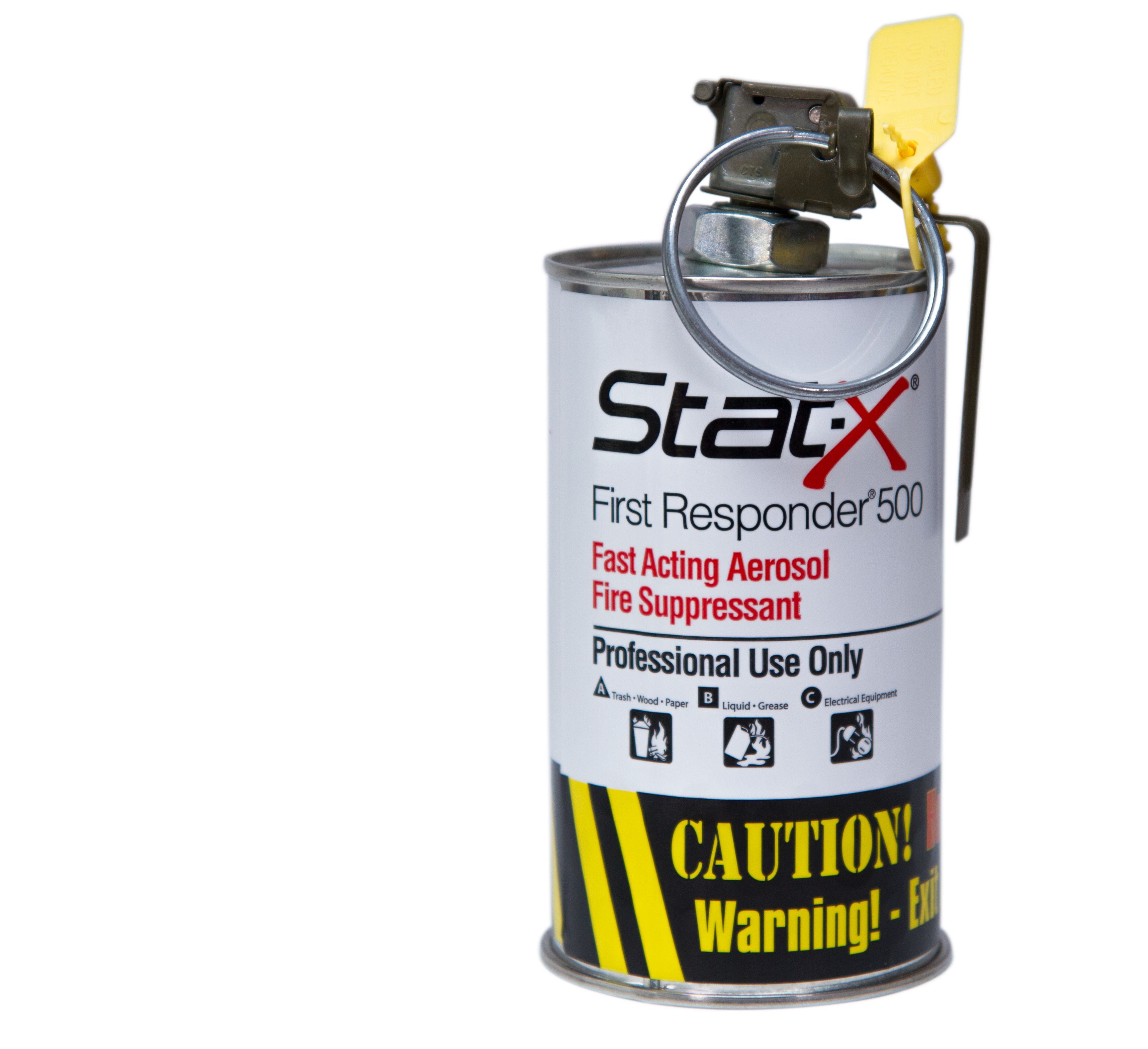
Authorized distributor. Kidde Fire Systems, Sevo Systems, FireFlex, Stat-X, Notifier by Honeywell and Xtralis VESDA. That range means agent selection is driven by the hazard rather than by whichever line we happen to carry.
Engineering in house. Hydraulic calculation, agent quantity, nozzle placement and enclosure assessment are done by our own staff, not passed to a third party. [CONFIRM]
24-hour emergency service, and a 12-month warranty on installation and labour.
Service coverage for clean agent cylinder refilling in the GTA, Mississauga, Ottawa, Calgary, Edmonton and Vancouver.
Get a clean agent system specified for your space
Room volume, ceiling construction, existing detection and enclosure integrity all have to be measured before anyone can quote a system honestly. We will assess the space and come back with an agent recommendation, a design and a number.
Request a quote 1-866-384-1280
NFPA 2001 requires a monthly visual check, a cylinder weight or level check every six months, and a full functional test of detection and releasing circuits annually. Cylinders require hydrostatic testing every five years. Enclosure integrity should be retested after any renovation, cable work or HVAC change that affects how well the room holds agent. An authority having jurisdiction can require more.