













Fire Protection for Modular and Containerized Data Centres
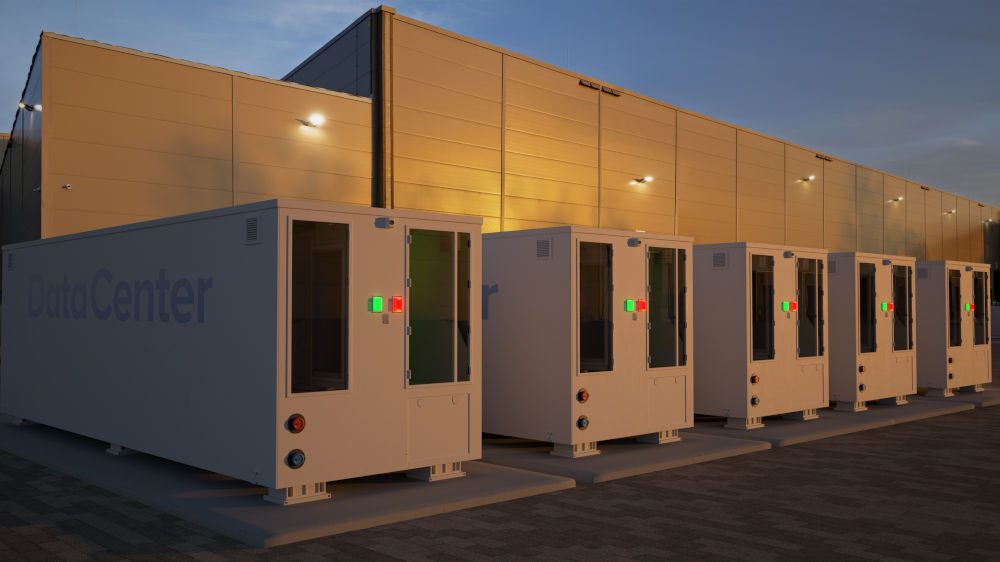
Fire protection for modular and containerized data centres follows the same principles as a built data hall, applied to a space that is smaller, tighter, often unoccupied, and sometimes a long way from a fire hall. The difference is not the physics. It is that a container-sized enclosure gives you much less margin on detection, enclosure integrity, pressure relief and response time, and that a module built in a factory has to be proven again after it has been trucked to site.
The same reasoning applies at smaller scales. A containerized edge deployment, a prefabricated IT room dropped into an industrial site, or a single hardened server enclosure in a remote facility all face a version of the same problem. This guide works from the module outward.
Explore further
Key takeaways
- Assess the module and the site separately , and again whenever a second module arrives beside the first.
- Design detection for the airflow , with aspirating sampling at return paths as the usual starting point.
- Prove enclosure integrity and pressure relief on site after transport , not on the factory floor.
- Treat the battery enclosure as its own hazard , with its own detection, ventilation and cooling strategy.
- Write the site retest scope into the purchase order , so acceptance is contractual rather than negotiable on delivery day.
What makes modular data centres different
Prefabricated modules, ISO-style enclosures and containerized edge installations share a set of characteristics that matter for fire protection:
- Small air volume. A fire that would be a nuisance in a data hall is a significant event in 30 cubic metres.
- High air change rate. Cooling a dense IT load in a small box means a lot of air moving fast.
- Tight, conductive enclosure. A steel shell behaves differently from a gypsum-and-block room, both structurally and thermally.
- Low or no occupancy. Nobody is there to smell smoke, and nobody is there to respond.
- Remote or constrained sites. Emergency response distance can be measured in tens of minutes.
- Temperature extremes. A module on a Prairie site in January and the same module in August are different design cases.
- Transport. The system is built in one place, shaken for several hundred kilometres, and operated in another.
- Expansion by replication. Modules get added next to each other, which raises exposure and separation questions nobody asked at module one.
Assess each module and the surrounding site
Two assessments are needed, and projects often do only the first.
Inside the module: IT load and electrical distribution, cable entries and penetrations, UPS and battery chemistry, cooling arrangement and airflow paths, wall and roof construction and its fire performance, internal compartmentation if any, and access for service.
Around the module: physical separation from neighbouring modules and buildings, exposure if an adjacent module burns, site access for apparatus, available water supply if any, emergency response distance, and whether anyone is normally on site.
A module that is compliant in isolation can still create an unacceptable arrangement when four of them are parked two metres apart. Separation and exposure are site-level questions, and the authority having jurisdiction will treat them as such.
Early detection in small high-airflow enclosures
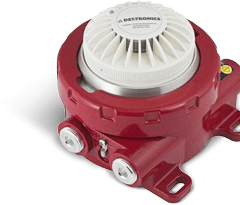
Spot smoke detectors are designed for still or slowly moving air. In a container with high air change rates and a short distance between supply and return, smoke can be diluted and swept past a ceiling-mounted detector before it accumulates enough to alarm.
Aspirating smoke detection is the usual answer, with sampling at or near return air paths, where products of combustion concentrate before recirculation. Two design points get missed:
People also search
- Dilution is part of the system's sensitivity. UK Fire Industry Association guidance treats the sampling pipe network as part of the overall sensitivity class, which is why class selection has to account for the air being drawn through the pipe, not just the detector's rated sensitivity.
- Transport time is bounded. That same guidance sets a maximum sample transport time, which constrains how long a pipe run can be. In a container this is rarely the binding constraint, but in a multi-module arrangement with a shared detector it can be.
Also plan for the environment. Dust during construction, exhaust near a loading area, humidity swings and insect ingress all affect sampling systems, and filters and detector access have to be reachable without taking the module out of service.
Choosing suppression for containerized facilities
The selection logic is the same as anywhere else: what is burning, where is the enclosure boundary, is the space occupied, and what will the authority having jurisdiction and the insurer accept. The constraints are tighter.
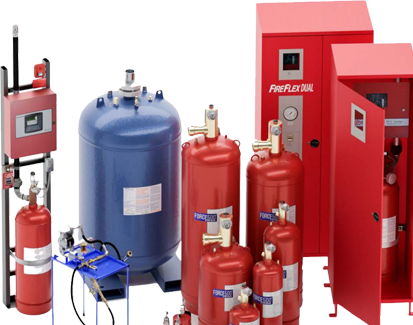
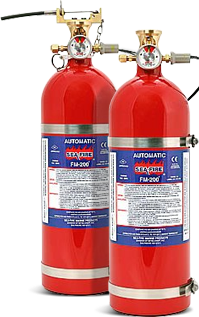
Clean agent and inert gas systems are common in container-scale IT enclosures because the hazard is electrical and the goal is to avoid wetting equipment. They depend on an enclosure that can hold concentration and on correctly sized pressure relief. In a small volume, both are harder than they look.
Pre-action and other water-based systems remain relevant where the site, the code or the insurer requires them, particularly where a module sits within or adjacent to a protected building.
Localized and in-cabinet protection addresses a specific hazard at its source. A cabinet-level detection and suppression arrangement can be the right answer for a single hardened enclosure or a small edge deployment, where total flooding a whole container would be disproportionate.
Three constraints specific to containers:
- Temperature extremes affect agent cylinder pressure and therefore discharge behaviour, which is why design temperature range is an explicit input rather than an assumption. Heat and cold also change how detection and suppression equipment performs well beyond the cylinders.
- Refill logistics. A discharged cylinder at a remote site is a transport and scheduling problem, not just a service call.
- Compartment integrity after transport. See below.
Pressure relief, ventilation and enclosure integrity
This is where container projects most often get caught.
Gaseous suppression in a small, tight enclosure produces a meaningful pressure excursion. The required free vent area comes out of a calculation using the agent, the quantity, the discharge profile and the allowable enclosure pressure. That last figure has to come from someone who knows what the structure can take. A shipping container shell is strong in some directions and not others, and its doors, seals and any cut openings are part of the answer. Inert gas systems generally need considerably more vent area than halocarbon systems, because the full agent quantity arrives as gas.
The enclosure integrity side needs the same discipline. Hold time depends on leakage, and a container has door seals, cable entries, cooling penetrations and vent openings that all leak. Door fan testing is how leakage is measured, and surveys of installed systems repeatedly find pressure relief vents fitted backwards, obstructed, or simply absent. Test what is installed, not what was specified.
Insurer guidance on extinguishing system acceptance treats enclosure testing as something done at installation and then periodically, rather than once at the factory. That is the right instinct for a module, for reasons that come up again under acceptance testing below.
Batteries and thermal runaway planning
A battery enclosure is a different design problem from an IT enclosure, and the most common modular project mistake is treating one clean agent system as covering both.
Lithium-ion cells vent flammable gas before they ignite. Off-gas detection exists to use that window, and it gives earlier warning than smoke or heat detection in a thermal runaway sequence. A gaseous agent can address a fire in the enclosure, but it does not remove the heat already stored in a cell in runaway, so reignition is a real scenario and cooling has to be thought about separately.
Where a battery installation is large enough, explosion control becomes a distinct design layer rather than an afterthought: mechanical exhaust to prevent an accumulation of flammable gas, and deflagration venting to manage one if it forms. Testing to UL 9540A at the relevant level produces the fire propagation data that supports those decisions; it is a test method that informs installation design, not a pass-or-fail approval. NFPA 855 is the reference standard for stationary energy storage installations, with applicability depending on chemistry, capacity and location.
Where a module contains both IT equipment and a significant battery system, expect the designer to separate them physically, or to justify in writing why they have not. The boundary between IT protection and battery energy storage fire suppression is where modular designs most often need a second opinion.
Fire alarm integration and remote monitoring
An unoccupied module announces its own problems or nobody hears them.
What the design has to settle:
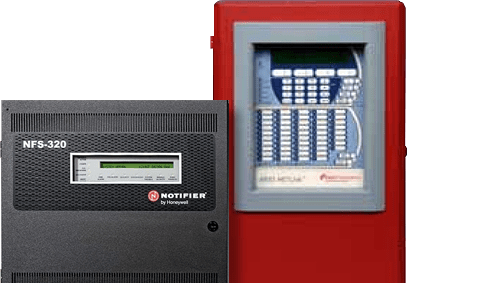
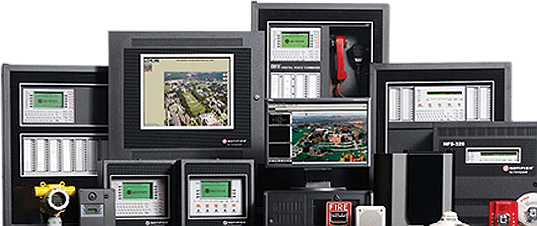
- Which signals leave the module, and where they go: site fire alarm panel, building automation system, remote monitoring centre, or all three
- How alarm, trouble and supervisory conditions are distinguished at each destination
- What happens on loss of communication, and how quickly that is noticed
- Power supply and standby capacity for the detection and releasing equipment
- Release sequence interfaces: cooling shutdown, dampers, power disconnect, discharge confirmation
- Access control interaction, so that responders can get in and the module is not holding a door shut against them
Loss of communication deserves particular attention at remote sites. A module that has been silently offline for six weeks has been unprotected in practice, whatever the drawings say.
Factory acceptance, site acceptance and relocation
A system that passed a functional test on the factory floor has not been proven on site. Between those two points it has been lifted, trucked, vibrated for hours, possibly stored outdoors, and reconnected.
Factory acceptance reasonably covers panel programming and sequence logic, device operation, detector function, and interface behaviour under simulated conditions. It is efficient and worth doing.
Site acceptance has to cover everything that transport and installation could have changed: pipework integrity and supports, cylinder mounting and pressure, detector and sampling pipe condition, cable terminations, door seals, vent presence and orientation, enclosure leakage, and the interfaces to anything on site that did not exist in the factory. Enclosure integrity in particular cannot be inherited from a factory test, because the leakage path through a module that has been road-transported and reassembled is not the leakage path that was measured.
Relocation restarts this. Moving a module is not a logistics exercise with a fire protection footnote; it is a change that requires re-verification and, in many jurisdictions, fresh review.
Checklist before purchasing a container
Ask the vendor for the following, in writing, before the purchase order rather than after delivery:
- ◻ Listings and approvals for the detection and suppression equipment, and confirmation of marks valid for Canada
- ◻ The design basis: which codes and standards the fire protection was designed to, and which editions
- ◻ Drawings: detection layout, pipework, cylinder location, vent location and free area
- ◻ Agent type, quantity, design concentration and design temperature range
- ◻ The enclosure pressure calculation and the stated allowable enclosure pressure
- ◻ Battery specification, chemistry, and any UL 9540A test data at the relevant level
- ◻ Cause-and-effect matrix and sequence of operations
- ◻ Interface schedule: what connects to site fire alarm, BAS and monitoring
- ◻ Climate limits for operation and storage
- ◻ Factory test reports, and a written statement of what will be retested on site
- ◻ Service plan, including refill and cylinder testing logistics at the module's location
- ◻ A named engineer of record, where the project requires one
A vendor who can answer all of these quickly has done this before. One who cannot is proposing that you find the gaps during commissioning.
Canadian code realities for modular builds
Canada has no single national rule for factory-built structures. The National Building Code and National Fire Code are model documents that each province and territory adopts, sometimes with amendments and often on different edition cycles. NFPA standards carry legal weight where an adopted code references them, where a specification calls them up, or where the authority having jurisdiction or the insurer requires them. NFPA 75 addresses information technology equipment areas, and research into Canadian modular construction notes that provincial treatment of factory-built and relocatable structures varies considerably: CSA A277 is the main factory certification route, its weight differs by province, and many authorities re-inspect modules after they arrive.
Two practical consequences. First, a module certified in a factory in one province may still face inspection and approval at its destination. Second, a product mark that is valid in the United States is not automatically accepted in Canada; look for marks indicating evaluation to Canadian requirements. Confirm the route with the receiving AHJ early, because it shapes the documentation package.
Frequently asked questions
Do containerized data centres need sprinklers? It depends on what the adopted code, the authority having jurisdiction and the insurer require for that occupancy and site. Gaseous suppression inside the module and water-based protection at the site level are not mutually exclusive.
Does a clean agent system work in a container? It can, provided the enclosure holds concentration for the required period and the pressure relief is sized for the actual enclosure and agent quantity. Both have to be demonstrated, not assumed.
Can we rely on the factory test? Use it for what it proves: programming, device function and sequence logic. Pipework, cylinder mounting, enclosure leakage, vents and site interfaces all need site verification after transport.
How do batteries change the design? Significantly. Lithium-ion hazards call for off-gas detection, separate assessment, possible explosion control and a cooling strategy. A clean agent system sized for the IT load does not address thermal runaway.
What happens when we add a second module? Separation, exposure and shared monitoring all need review, and the site-level assessment that covered one module may no longer hold.
How do refills work at a remote site? Plan them. Cylinder transport, hydrostatic testing intervals and service access are logistics problems that should be priced and scheduled before the module ships.
Does cold weather affect the suppression system? Yes. Ambient temperature affects cylinder pressure and discharge behaviour, so the design temperature range has to cover the site's real extremes.
Is NFPA 75 mandatory for a modular IT room in Canada? Not automatically. It applies where an adopted provincial code, a specification, the AHJ or an insurer requires it. Confirm the applicable edition for your jurisdiction.
Where to go next
The cheapest intervention on a modular project is a design review before the vendor's drawings are frozen. By delivery day the enclosure, the vent openings, the cylinder mounting and the interface list are all fixed, and changing any of them means cutting into a finished module. The procurement checklist above is written to be used at that earlier point.
Need help evaluating fire protection for your facility? Contact Control Fire Systems Ltd. to review special hazard risks, suppression and detection design, system integration, testing, and maintenance requirements. Modular and containerized projects are cheapest to correct at the engineering and design review stage, before the module ships.